?unique=d68bd7a)
Digital Twins are becoming a key technology for industrial transformation. They allow companies to create digital representations of machines, production lines, processes or even entire factories as shown in the Digital Twin project. Through these models, organizations can simulate operations, predict failures, optimize resources and support better decision-making.
However, the value of a Digital Twin depends on one essential factor: the quality of the data that feeds it.
A Digital Twin is not useful simply because it visualizes an asset or reproduces a process. Its real value comes from its ability to reflect what is happening in the physical world with accuracy. If the data is incomplete, outdated, inconsistent or poorly contextualized, the model may provide a distorted view of reality.
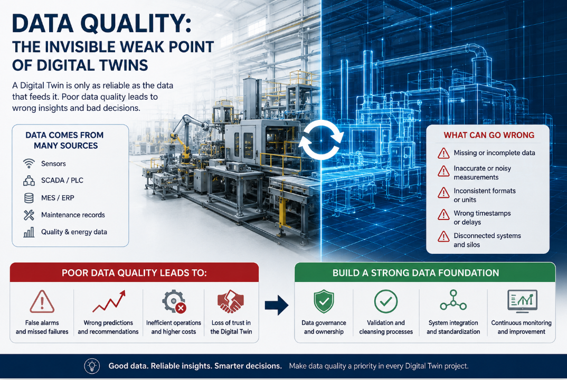
In industrial environments, data usually comes from many different sources: sensors, SCADA systems, PLCs, ERPs, MES platforms, maintenance records, quality reports and energy monitoring tools. Bringing all this information together is complex. Each system may use different formats, update frequencies and levels of precision.
This creates several challenges such as missing values, duplicated records, incorrect timestamps, sensor drifts or inconsistent units of measurement that all these can reduce the reliability of the Digital Twin. For example, if a sensor is not properly calibrated, the model may base its predictions on inaccurate information. If timestamps are not synchronized, it may be difficult to understand the real sequence of events in a production process.
Poor data quality can directly affect decision-making. A predictive maintenance model may generate false alarms, an optimization system may recommend inefficient settings, or a simulation may fail to represent the real limitations of the factory floor. Over time, this can reduce trust in technology among operators, engineers and managers.
For this reason, data quality should be treated as a priority from the beginning of any Digital Twin project. Companies need clear data governance, validation processes, system integration and continuous monitoring. It is not enough to collect large amounts of data; the data must be accurate, consistent, contextualized and useful.
Digital Twins have enormous potential, but they require a strong data foundation. Without reliable data, even the most advanced model cannot deliver reliable insights.
Check our project website and our Social Media profiles

Funded by the European Union. Views and opinions expressed are however those of the author(s) only and do not necessarily reflect those of the European Union or the European Education and Culture Executive Agency (EACEA). Neither the European Union nor EACEA can be held responsible for them.